吴恩达:带出 AI 原生团队的 4P 框架
吴恩达分享AI原生团队搭建4P框架,为工程管理者提供可落地的实操指引。 1. AI原生工程团队的核心定位与建设目标 2. 小型新团队搭建AI原生团队的起步思路 3. 大型企业存量工程团队的AI化转型方向
Dear friends,
亲爱的朋友们:
What should an engineering leader such as a VP Engineering or an Engineering manager do to help their team become more proficient in AI? I speak regularly with engineering leaders, and want to share some effective practices.
工程副总裁、工程经理这样的工程领导者,该怎么做才能让团队更熟练地掌握 AI?我经常与工程领导者交流,想分享一些行之有效的做法。
If you're starting a new team of 2-3 persons, you can start with exclusively AI-native people, but many large companies have to find ways to move existing teams forward. The goal is not a traditional engineering team that uses AI, but rather an AI-native engineering team that is designed to take advantage of AI's capabilities and work around its bottlenecks.
如果你要组建一支两三人的新团队,可以从一开始就只用 AI 原生人才;但许多大公司必须找到办法,让现有团队向前走。目标不是一支「会使用 AI 的传统工程团队」,而是一支 AI 原生工程团队——它的设计就是为了发挥 AI 的长处,并绕开 AI 的瓶颈。
This is a bilingual presentation of Andrew Ng's article "The Four Ps — A Leadership Framework: How to Manage An AI-Native Engineering Team" (The Batch, deeplearning.ai, October 23, 2026). English text is presented verbatim from the original; Chinese is our translation.
本文为吴恩达(Andrew Ng)文章《The Four Ps — A Leadership Framework》(The Batch,deeplearning.ai)双语对照呈现,副题「如何管理一支 AI 原生工程团队」。英文照录原文,中文为观澜译文。
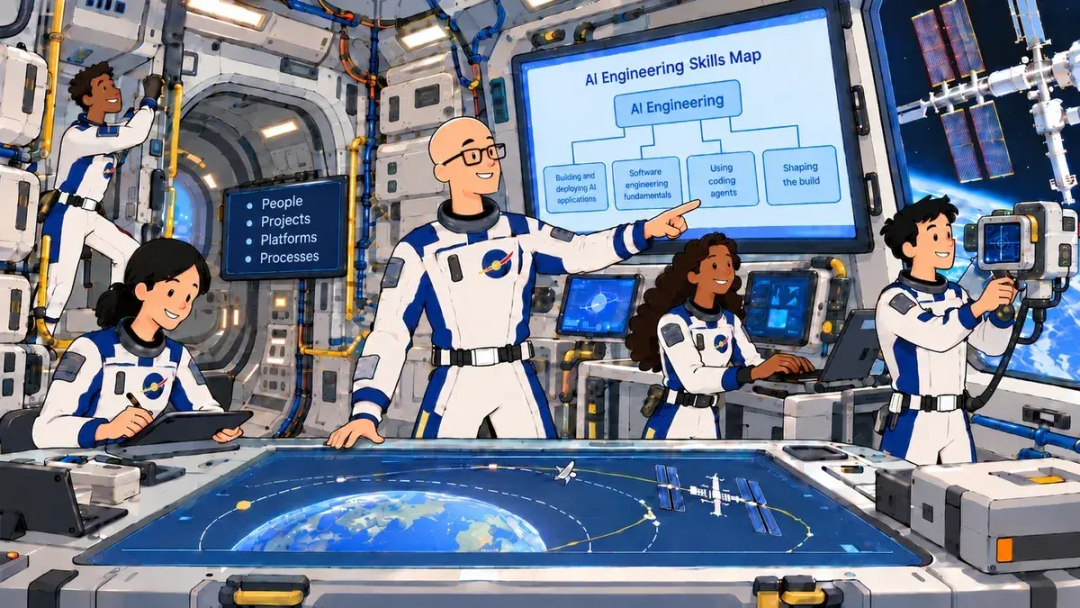
The Batch 官方题图:AI Engineering Skills Map(图源:The Batch)
一、人才(People)
People. First, support individual development. Teams are made up of people, and for it to be AI-native, its individuals have to be proficient in the technology and its use. Encourage your team to become skilled at AI Engineering, provide space and budget for experimentation, and set a culture that encourages this growth.
人才。第一,支持个人成长。团队由人组成;团队要成为 AI 原生,团队里的每个人就必须熟练掌握这门技术及其使用。鼓励团队精通 AI 工程(AI Engineering),为实验提供空间和预算,并培育一种鼓励这种成长的文化。
Additionally, many engineering leaders are themselves hands-on builders or have returned to being more hands-on since coding agents have made it easier. You can't know what it feels like to ride a bicycle just by watching others do it; you have to hop on a bike yourself.
此外,许多工程领导者本身就是动手型建造者,或者自从编程智能体让动手变容易后,又重新回到了更动手的状态。光看别人骑自行车,你不会知道骑车是什么感觉;你必须自己跨上车。
And you can't know what it feels like to steer a coding agent or build and deploy AI systems unless you're at least occasionally doing it yourself. So take the time to build your own projects. The intuitions you develop will improve your judgement on both technical and business decisions.
同样,如果不至少偶尔亲自动手,你就无法体会驾驭编程智能体、构建和部署 AI 系统是什么感觉。所以,请花时间做你自己的项目。你由此培养出的直觉,会提升你在技术决策和商业决策两方面的判断力。
二、项目(Projects)
Projects. Execute promising projects. As I've written previously, we should invest in bottom-up innovation. However, additional top-down backing of a handful of promising projects is important for them to scale and show business impact.
项目。执行有前景的项目。正如我此前写过的,我们应当投资自下而上的创新。但对少数几个有前景的项目追加自上而下的支持同样重要——这关系到它们能否规模化、能否展现业务影响。
Engineering leaders who understand AI technology better than other business functions do have a critical role to play in helping companies select these projects. Far too many businesses are still thinking of AI as primarily a way to increase efficiency and save costs.
相比其他业务职能部门,工程领导者更懂 AI 技术,在帮助公司挑选这些项目上确实扮演着关键角色。太多的企业仍然把 AI 主要当作提效降本的手段。
Yes, it can do that, but the opportunities to create new products and find new ways to serve users — and drive growth — are far larger, so in your mix of projects, please include some ideas for growth!
它确实能做到这一点,但创造新产品、找到服务用户的新方式——进而驱动增长——的机会要大得多。所以,请在你的项目组合里,纳入一些面向增长的想法!
三、平台(Platforms)
Platforms. Invest in infrastructure to enable AI use. Organize your data to make it easy for developers to get their agents the relevant context and take appropriate actions.
平台。投资建设让 AI 用得起来的基础设施。整理好你的数据,让开发者能轻松地为自己的智能体提供相关上下文、并让它采取恰当的行动。
I find the work to be done in this area varies significantly by organization, but it might involve — with appropriate security and governance — making repositories visible to agents, setting up documentation such as product design decisions and support tickets to be accessible to agents, other data infrastructure work to make your data agent-ready, and creating internal tools for agents to use.
我发现这方面要做的工作因组织而异,但可能包括:在适当的安全与治理前提下,让代码仓库对智能体可见;把产品设计决策、支持工单这类文档整理成智能体可访问;做其他数据基础设施工作,让数据「智能体可用」;以及创建供智能体使用的内部工具。
You might also set up AI code review tools, CI pipelines to help agents debug and deploy, infrastructure for agents to run on (like sandboxes, or maybe just a lot of Mac minis), and ways to codify and share reusable agent skills. Or for some businesses, the first step may be to persuade the CIO that it's high time to let your developers stop coding exclusively by hand and use agents. That, too, would be progress!
你还可以配置 AI 代码评审工具、帮助智能体调试和部署的 CI 流水线、供智能体运行的基础设施(比如沙箱,或者干脆是一大批 Mac mini),以及把可复用的智能体技能固化下来并共享的方法。而对某些企业来说,第一步也许是说服 CIO:是时候让开发者别再纯手工写代码,改用智能体了。那也是一种进步!
四、流程(Processes)
Processes. Redesign processes around AI's new bottlenecks. On most of my teams, engineers help shape the build by participating in product management decisions, and sometimes also in marketing, design, etc. The cost of building software to a clear spec has fallen dramatically, making everything else seem like a bottleneck in comparison.
流程。围绕 AI 带来的新瓶颈,重新设计流程。在我带过的大多数团队里,工程师通过参与产品管理决策来参与塑造产品,有时也参与市场、设计等环节。按明确规格把软件做出来的成本已大幅下降;相形之下,其他一切环节都像是瓶颈。
A skilled team that either knows, or can figure out, what to build can get the job done quickly, if we let them. So form high-context, high-empowerment teams that have the information they need and are empowered to act (subject to modest safeguards against significant risks, like leaking confidential data, a major outage, or data loss).
一支熟练的团队,只要知道(或者能想明白)要做什么,而且我们放手让他们干,就能很快把活干完。所以,请组建「高上下文、高授权」的团队:他们拥有所需的信息,也被授权直接行动(前提是有适度的防护措施,防范重大风险,比如机密数据泄露、大规模服务中断或数据丢失)。
We still have the age-old problem of coordinating among individuals and teams — we want to empower people to move quickly, while keeping teams aligned in building toward a greater whole. Practices here are still emerging, but getting different teams' agents to share information with each other is a promising direction.
个体与团队之间的协调仍是那个老问题——我们既要让人们跑得快,又要让各团队方向一致、共同拼成一个更大的整体。这方面的实践还在成形,但让不同团队的智能体相互共享信息,是一个有希望的方向。
Whatever your position, I hope this framework of People, Projects, Platforms, and Processes helps you move your organization forward. And if you have a boss who you'd like to partner with to implement such changes, consider forwarding this email to them!
无论你身处什么职位,希望这个「人才、项目、平台、流程」框架能帮你推动组织向前。如果你有一位愿意与你搭档推动这些改变的上级,不妨把这封邮件转发给他!
Keep building!
继续构建!
Andrew
吴恩达(Andrew)
立即咨询 JOTO
JOTO 提供覆盖企业智能体规划与搭建、AI 平台私有化部署、RAG 知识工程、AI 安全治理、FDE 驻场共创及持续运营优化的全周期 AI 落地服务,帮助企业把验证中的 AI 能力转化为安全、可控、可持续迭代的生产力。 联系 JOTO 获取 AI 落地咨询
想把这些做法用到你的业务里?
留下你的场景和痛点,我们帮你判断从哪一步开始。
联系我们